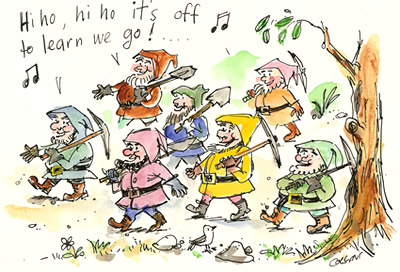
(An example of a community of practice)
In the global space of communities of information, it is often a case of nature versus nurture. By this it can be understood that creating communities of practice or inquiry can be either helped by the rapid development of economies of knowledge; i.e. a case of natural development in society. Alternatively it can be restricted by a sense of nurturing of the old ways to harbor information within a particular community, rather than sharing this data for the greater good of society. This blogpost will discuss these conflicts in relation to the Communities of Practice class of the MA in Digital Humanities, here in UCC, which will take place on Monday the 5th of November 2012. This class will allow us to experience active discussions of Etienne Wenger's Introduction to Communities of Practice and the Introduction and first chapter of Wikinomics, using digital conferencing methods.
It is now time to create the foundations for walking the walk within Digital Humanities:
(Wenger discusses his work with Brantlee Underhill, PMI Director of Pratitioner Markets)
Looking at Wenger's work it is clear that the concept of communities of practice is well established, yet underrated. Like many structures of economy, learning and society, a lack of communication thus far outside of the walls of these sectors has allowed for this idea to escape our notice. With the rapid expansion of all things technology based, we can now experience the true value of communities of practice. Examining Wenger's definition, he states that "communities of practice are groups of people who share a concern or a passion for something they do and learn how to do it better as they interact regularly" (Communities of Practice: A Brief Introduction). This statement invites the question of whether there are elements of failure within this scheme? Can a community of practice deteriorate through loss of this concern or passion, and should there be regulations in place in order to deal with these losses?
There is also the issue of those who are forgotten when the community of practice evolves into its largest, most openly creative form. These are the hoarders. Those who hide in their offices, sitting on valuable information.

(Image obtained from www.123rf.com)
They are also those who are afraid of change.

The process of growth within communities of practice reminds me of a kind of information farming. Ideas are grown through nourishment, when seeds are planted by engagement with the foundations, which in this case is the wider community of the world. It has been argued that people are the "tangible assests" of modern day organisations, whether they are internal or external to that organisation (Leveraging Communities of Practice for Strategic Advantage, 3). This is becoming more and more evident in our own University structure. The engagement of students within the knowledge economy of their degree makes them a valuable external asset to the internal teaching practices of their lecturers. These contributions also come from external sources outside of the University community, such as interaction with greater society. Without the external influences of the students, the Universities assets are diminished. The University is no longer a closed network of learning. We are engaging in global connectivity with other colleges to improve our own systems.
A statement which struck me as very controversial came in the form of the closing words from the first chapter of Wikinomics. "Collaborate or perish", which is also the title of this post, seemed slightly dramatic in essence and certainly retained its shock value. I think that again it overlooks societies ability to adapt as a whole, and does not acknowledge the fact that people progress at different rates. It is evident that this threat is meant to challenge the hierarchy of information. However, one needs to ask the question as to whether threats will get a progressing system anywhere?
The book itself provides a template which my own class could use for creating a work of collaboration.The example of using the development of a subtitle as an open web discussion highlighted the multi-dimensional applications of 'wikinomics' in the field of digital humanities. "Within twenty-four hours we had dozens of great subtitle suggestions" (Wikinomics, 4). It defies the structure of a normal book, in that it was created by many, who were given the open opportunity to participate in constructing the framework for headings associated with the chapters through the online forum, rather than excluding useful knowledge through writing and publishing agreements. I think that they put it best in this chapter with the line that they will "harness some of the best minds in the Industry" using these methods of community (Wikinomics,8). There is also a significant element of acknowledgement and gratification in this practice. New, skillful members of society are uncovered, who would otherwise have gone overlooked. Open source puts all of these ideas highlighted by Tapscott and Williams into practice.
When I imagine this in terms of what we are doing in this course, I envision class projects in which we collaborate in a virtual space to create a body of work outside of the classroom, such as a shared blog. The various examples of public 'peering' throughout this work provide some very applicable models for our own MA to think about when we begin to face the challenges that lie ahead in Digital Humanities. These examples, such as the Gold Mining story, face both the problems and benefits which any community of practice will encounter when engaging in collaboration. Forbes provides a comprehensive list of tips for virtual collaboration, which I think will prove useful in the context of this course. These are as follows:
- Increase cross cultural awareness
- Co-create team rules and norms
- Build virtual trust
- Mix communication mediums
- Make the first meeting face to face
I thought that this list would be helpful in building our own online community of practice using this course as a backbone. In particular I felt that the elements of trust and regulation would keep the group working fluidly.
There was one discussion in this chapter in particular which drew my attention. The 'Promise and Peril' section underlined the dangers which the idea of communities of practice can attract. Alongside these communities who mean well with their intentions for collaborating are those involved in criminal collaboration. The inclusion of this section was worthwhile in exposing the negative types of collaboration which still exist in such a developing area. It synopsizes the negative and positive kinds of teamwork out there and that while communities of practice are revolutionary in theory, they are not without their problems.
Another aspect of the perils which I would like to discuss is the "mass mediocrity" problem. Coming from a literary studies background, the suffocating of authentic voices due to over-saturation of digital voices is one of my greatest fears. I am glad that it has been recognised here. I link this back to literature by arguing that the literary market-place may become flooded by mediocre 'writers', meanwhile true, talented voices of literature may be lost in the influx. This idea follows into the debate made by James E. Gall about the conflict in this book between profit and sharing. "The apparent contradiction created between the openness/sharing philosophy and the personal/corporate profit angle is the greatest weakness of this book" (Gall, 362). Literature is a prime example of this in that free, open source literature follows this model, but professional writers also need to make a profit. Therefore how do we merge the two, without stifling the professional literary marketplace? I agree that there are many contradictions involving these two areas in this book, however it would be wrong to overlook the economic factors, in order to promote this cause.
To conclude, I consider both of these works to warrant a dynamic debate amongst my peers in Mondays class. I found them both useful for contextualising the system of communities of practice in my own mind.
They also categorised the dark side of these communities, which are a valuable element to be aware of when engaging in them. Although both were a bit over zealous in their promotions of COP's or Wikinomics, they provided many valid points on why this is the way forward. However, if we are to practice what these works preach, we must do so with caution so as not to lose sight of true creativity. I think that we should also encourage the nurturers of old traditions to follow the progressing digital path. The only way that we can persuade them to do this is by demonstrating the effectiveness of creating our own society of knowledge building through global, digital means, leaving them no choice but to walk the walk alongside us.
Works Cited
Gall, James E. 'The Cult of the Amateur by Andrew Keen; Wikinomics: How Mass Collaboration Changes Everything by Donald Tapscott, Anthony D. William, Review', Educational Technology Research and Development. 53.3 (2008): 361-4, Jstor, 3 Oct. 2012. Web.
Saint-Onge, Hubert, Debra Wallace. Leveraging Communities of Practice for Strategic Advantage. Oxford: Butterworth-Heinemann, 2003. Print.
Wenger, Etienne. Communities of Practice: A Brief Introduction. Web. June (2006). http://www.ewenger.com/theory/
William, Anthony D., Donald Tapscott. Wikinomics: How Mass Collaboration Changes Everything. Web, (2008). http://www.wikinomics.com/book/IntroAndOne.pdf


