Showing posts with label Pharmakon. Show all posts

Tuesday, 12 March 2013

Masking Reality: Baudrillard and the Simulacrum


Having read Jean Baudrillard's  philosophical work, Simulacra and Simulation for a recent MA class, I have come to the conclusion that it is a difficult task to navigate the literary minefield of postmodernist theory, no matter how well you think that you understand it. The following post will attempt to shed some light upon Baudrillard's philosophical musings in this complicated work.

The simulacrum is advocated as a mask or representation which conceals the lack of truth within reality. The word simulacrum is derived from the Latin  which translates to 'likeness or similarity'. Baudrillard presents the simulacrum to be the only truth in this world of falsities. His theory proposes that there is no original, there are only copies of things, which the simulacrum exposes. This ability to expose the truth of falsity represents the simulacrums threat to society.

The key examples which Baudrillard uses to support his argument are that of Disneyland and the Watergate Scandal. These examples are analysed as false distinctions and they are the key to his idea of the "hyper-reality" (Baudrillard, 5). This is said to give us the sense that we can tell the difference between what is true and what is false; what is real and what is imagined; when really it is all just apart of the facade.

From a linguistic perspective it is important to focus upon Baudrillard's use of language; his use of Latin in this case. The very fact that the word Simulacrum is in a different language reinforces his argument upon masks. It evokes the word simulation also. He argues that "to simulate is to feign to have what one hasn't" (2). Baudrillard is questioning whether we have gained meaning from language at all or whether it has been lost in translation and in communication. One language masks another, which exemplifies the fact that there is no end to language in this hyper-reality. The 'word' provides meaning to that which is meaningless. In relation to language, this hyper-reality is endless, as language never ends. What I gathered from this insinuation of linguistics is that there is a cyclical nature evident in language, which effects representation, and how we view reality. What Baudrillard is examining through this idea is the nature of repetitiveness, and its lack of depth.

Nostalgia is strikingly apparent in this piece. Specifically a nostalgia for the real and for meaning. The identity of meaning within concepts of reality is striven for, yet Baudrillard considers it to be irretrievable in a postmodern world. An example of this theoretical application in modern society is the use of media, and its function as a distorter of reality. The image in media and advertising is often heavily embellished to evoke a sense of perfection and to make the consumer want to consume whatever product is being advertised.
Media theorists, especially Jean Baudrillard, have been intensely concerned with the concept of the simulation in lieu of its interaction with our notion of the real and the original, revealing in this preoccupation media's identity not as a means of communication, but as a means of representation (the work of art as a reflection of something fundamentally "real") (Devin Sandoz). 
 In other words, the meaning has been distorted or lost through the misinformation of media. The medium of the messages of the past have been miscommunicated in an effort to save representation. Therefore the aesthetic of truth has been preserved in favour of the actual truth of reality.

Graham Coulter-Smith has analysed Baudrillard's arguments in the following light:
"Baudrillard stands out almost by default as one of the few theorists to address the new postmodern technologies. However, his interpretation of these technologies appears unremittingly bleak and of limited value to contemporary visual artists. . ." (Jean Baudrillard, Art and Artefact, 91). This bleakness effects the message within his work, even going so far as to mask its own simplistic meaning.

Whether there is actually a crisis of identity happening in meaning is yet to be seen. Whilst Baudrillard's work is dramatic and provocative in effect, he fails to explore the nature of preservation which is happening in society, in reaction to the advancements of areas within technology and within new cultures. His opinions are very forceful, but they lack enough evidence. The example of Disneyland in particular does not explore the cultural connections which this theme park has to modern society or how the theme park works to preserve this cultural impact in a similar fashion to a museum. One could argue that the very elements which Baudrillard has discussed work in opposition to his ideas, in that they try to relate back to history and to act as reminders of our cultural journey.

Works Cited

Baudrillard, Jean. Mark Poster ed. Jean Baudrillard, Selected Writings. Stanford: Stanford UP, 1988. Print.

Web.

Zurbrugg, Nicholas, ed. Jean Baudrillard, Art and Artefact. London: Sage, 1997. Print.


Sunday, 4 November 2012

'Collaborate or Perish': Cultivating Information in the Modern World


(An example of a community of practice)


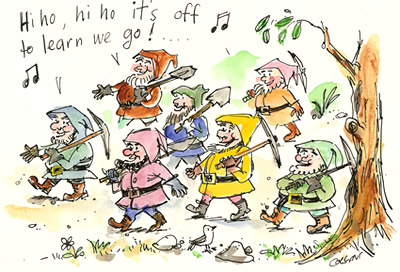
In the global space of communities of information, it is often a case of nature versus nurture. By this it can be understood that creating communities of practice or inquiry can be either helped by the rapid development of economies of knowledge; i.e. a case of natural development in society. Alternatively it can be restricted by a sense of nurturing of the old ways to harbor information within a particular community, rather than sharing this data for the greater good of society. This blogpost will discuss these conflicts in relation to the Communities of Practice class of the MA in Digital Humanities, here in UCC, which will take place on Monday the 5th of November 2012. This class will allow us to experience active discussions of Etienne Wenger's Introduction to Communities of Practice and the Introduction and first chapter of Wikinomics, using digital conferencing methods.

It is now time to create the foundations for walking the walk within Digital Humanities:

(Wenger discusses his work with Brantlee Underhill, PMI Director of Pratitioner Markets)


Looking at Wenger's work it is clear that the concept of communities of practice is well established, yet underrated. Like many structures of economy, learning and society, a lack of communication thus far outside of the walls of these sectors has allowed for this idea to escape our notice. With the rapid expansion of all things technology based, we can now experience the true value of communities of practice. Examining Wenger's definition, he states that "communities of practice are groups of people who share a concern or a passion for something they do and learn how to do it better as they interact regularly" (Communities of Practice: A Brief Introduction). This statement invites the question of whether there are elements of failure within this scheme? Can a community of practice deteriorate through loss of this concern or passion, and should there be regulations in place in order to deal with these losses?

There is also the issue of those who are forgotten when the community of practice evolves into its largest, most openly creative form. These are the hoarders. Those who hide in their offices, sitting on valuable information.

(Image obtained from www.123rf.com)

They are also those who are afraid of change.

These people also fall into the nurture category, when looking at the system of communities of practice. Is there a way of including these people so that they do not get left behind, or are they eternally stuck in this mindset? I think that the adaptability of the human race is underestimated in this sense. Arguably, Wegner and the Wikinomics writers have overlooked certain elements of human psychology, in that the crowd or tribe mentality is strongest, and that sooner or later the majority of non-believers will convert, once they perceive the great success of this method of global practice. Positivity is essential in the conversion of private practices of closed community to public practices of open community.

The process of growth within communities of practice reminds me of a kind of information farming. Ideas are grown through nourishment, when seeds are planted by engagement with the foundations, which in this case is the wider community of the world. It has been argued that people are the "tangible assests" of modern day organisations, whether they are internal or external to that organisation (Leveraging Communities of Practice for Strategic Advantage, 3). This is becoming more and more evident in our own University structure. The engagement of students within the knowledge economy of their degree makes them a valuable external asset to the internal teaching practices of their lecturers. These contributions also come from external sources outside of the University community, such as interaction with greater society. Without the external influences of the students, the Universities assets are diminished. The University is no longer a closed network of learning. We are engaging in global connectivity with other colleges to improve our own systems.

A statement which struck me as very controversial came in the form of the closing words from the first chapter of Wikinomics. "Collaborate or perish", which is also the title of this post, seemed slightly dramatic in essence and certainly retained its shock value. I think that again it overlooks societies ability to adapt as a whole, and does not acknowledge the fact  that people progress at different rates. It is evident that this threat is meant to challenge the hierarchy of information. However, one needs to ask the question as to whether threats will get a progressing system anywhere?

The book itself provides a template which my own class could use for creating a work of collaboration.The example of using the development of a subtitle as an open web discussion highlighted the multi-dimensional applications of 'wikinomics' in the field of digital humanities. "Within twenty-four hours we had dozens of great subtitle suggestions" (Wikinomics, 4). It defies the structure of a normal book, in that it was created by many, who were given the open opportunity to participate in constructing the framework for headings associated with the chapters through the online forum, rather than excluding useful knowledge through writing and publishing agreements. I think that they put it best in this chapter with the line that they will "harness some of the best minds in the Industry" using these methods of community (Wikinomics,8). There is also a significant element of acknowledgement and gratification in this practice. New, skillful members of society are uncovered, who would otherwise have gone overlooked. Open source puts all of these ideas highlighted by Tapscott and Williams into practice.

When I imagine this in terms of what we are doing in this course, I envision class projects in which we collaborate in a virtual space to create a body of work outside of the classroom, such as a shared blog. The various examples of public 'peering' throughout this work provide some very applicable models for our own MA to think about when we begin to face the challenges that lie ahead in Digital Humanities. These examples, such as the Gold Mining story, face both the problems and benefits which any community of practice will encounter when engaging in collaboration. Forbes provides a comprehensive list of tips for virtual collaboration, which I think will prove useful in the context of this course. These are as follows:


  1. Increase cross cultural awareness
  2. Co-create team rules and norms
  3. Build virtual trust
  4. Mix communication mediums
  5. Make the first meeting face to face


I thought that this list would be helpful in building our own online community of practice using this course as a backbone. In particular I felt that the elements of trust and regulation would keep the group working fluidly.

There was one discussion in this chapter in particular which drew my attention. The 'Promise and Peril' section underlined the dangers which the idea of communities of practice can attract. Alongside these communities who mean well with their intentions for collaborating are those involved in criminal collaboration. The inclusion of this section was worthwhile in exposing the negative types of collaboration which still exist in such a developing area. It synopsizes the negative and positive kinds of teamwork out there and that while communities of practice are revolutionary in theory, they are not without their problems.

 Another aspect of the perils which I would like to discuss is the "mass mediocrity" problem. Coming from a literary studies background, the suffocating of authentic voices due to over-saturation of digital voices is one of my greatest fears. I am glad that it has been recognised here. I link this back to literature  by arguing that the literary market-place may become flooded by mediocre 'writers', meanwhile true, talented voices of literature may be lost in the influx. This idea follows into the debate made by James E. Gall about the conflict in this book between profit and sharing. "The apparent contradiction created between the openness/sharing philosophy and the personal/corporate profit angle is the greatest weakness of this book" (Gall, 362). Literature is a prime example of this in that free, open source literature follows this model, but professional writers also need to make a profit. Therefore how do we merge the two, without stifling the professional literary marketplace? I agree that there are many contradictions involving these two areas in this book, however it would be wrong to overlook the economic factors, in order to promote this cause.

To conclude, I consider both of these works to warrant a dynamic debate amongst my peers in Mondays class. I found them both useful for contextualising the system of communities of practice in my own mind.
They also categorised the dark side of these communities, which are a valuable element to be aware of when engaging in them. Although both were a bit over zealous in their promotions of COP's or Wikinomics, they provided many valid points on why this is the way forward. However, if we are to practice what these works preach, we must do so with caution so as not to lose sight of true creativity. I think that we should also encourage the nurturers of old traditions to follow the progressing digital path. The only way that we can persuade them to do this is by demonstrating the effectiveness of creating our own society of knowledge building through global, digital means, leaving them no choice but to walk the walk alongside us.

Works Cited

Gall, James E. 'The Cult of the Amateur by Andrew Keen; Wikinomics: How Mass Collaboration Changes Everything by Donald Tapscott, Anthony D. William, Review', Educational Technology Research and Development. 53.3 (2008): 361-4, Jstor, 3 Oct. 2012. Web. 

Saint-Onge, Hubert, Debra Wallace. Leveraging Communities of Practice for Strategic Advantage. Oxford: Butterworth-Heinemann, 2003. Print.

Wenger, Etienne. Communities of Practice: A Brief Introduction. Web. June (2006). http://www.ewenger.com/theory/

William, Anthony D., Donald Tapscott. Wikinomics: How Mass Collaboration Changes Everything. Web, (2008). http://www.wikinomics.com/book/IntroAndOne.pdf


Tuesday, 23 October 2012

The Humanities Identity Crisis and it's 'Pharmakon'

Image taken from digitalmilieu.net

It has occurred to me that the Humanities discipline has undergone somewhat of an identity crisis in the past years. This post will discuss the mid-life crisis of the Humanities which has driven the movement in Digital Humanities forward.

Some, if not all, of the reading which I have been doing has reflected upon this crisis of identity and image which has swept over the Humanities as I.T. has taken over the world. Many have turned to I.T. in this crisis of progression to create an image based on trend rather than functionality and understanding. I would like to propose that Digital Humanities forgoes style for substance in the application of I.T. to its mission.

Alan Liu deals with this issue in his work The State of the Digital Humanities- A report and a critique, of which there is also a video available of him delivering this paper. In this report, he satirises the obsession with the image of I.T., which he refers to as an "institutional desiring engine" (2). There is a domineering strand of cultural I.T. in which image is everything. These people are building their I.T. identity based upon trends, rather than acknowledging the impact of technology upon Modern research and innovation. These type of users can be referred to as mindless participators in I.T., whereas those who have entered into their work using digital means can be identified as mindful participators. Arguably, digital humanists fall into this category. They recognise the character and adaptability of the uses of I.T. in their work, unlike those mindless users who are mainly concerned with the appearance that they will gain from these 'cool' gadgets. It is my opinion that the digital world cannot reach its full potential if it remains obsessed with its own cultural image.

An example of a mindless user of I.T.


Now, you may ask, what does this theory have to do with the crisis of identity in the Humanities? The answer to this is everything. Humanities is also in danger of falling into the mindless participator role, if old conventions on the uses of I.T. cannot be forgotten. The Humanities in general have been at a cross-roads for some time in terms of its image. William Pannapacker has discussed this attempt to re-define the Humanities in his work: Big Tent Digital Humanities: A view from the edge, part 2, starting with its problems: 


"Some are related to the traditions of academic culture—the apparent disinclination of some humanists to work with digital technologies, the academic tendency to value individual achievement over teamwork, and the continuing emphasis on the use of scholarly monographs to certify tenure and promotion. Other challenges seem more structural, such as declining financial support for the humanities in general" (Pannapacker).

 Pannapacker hits the nail on the head with this article, traditions within the Humanities are proving hard to shake. Conceivably, many humanists understand the idea of integrating I.T. with research, but do not understand its importance and essentiality for the future of the identity of the Humanities. Susan Schriebman categorises this as a lack of knowledge within the humanities of the depth of the digital. Humanities has mainly perceived the surface of technology, yet there seems to be this fear of learning about the operating functions 'beneath the hood' of today's computer, in order to attain its full potential. Her work, Digital Humanities: Centres and Peripheries, argues that "it was felt it was not enough for our peers to come to terms with surface technologies, they also needed to understand the inside of the beast" (6).

While reading Suzanne Guerlac's article "Humanities 2.0: E-Learning in the Digital world", I was struck by her closing arguments regarding all things digital:

"As Bernard Stiegler suggests, technology is a kind of pharmakon, by which he means (via Plato and Derrida) that it is both a remedy and a poison.To know the difference, however, it is essential that we become computer literate and that universities support what Drucker calls “humanistic approaches” to manipulations of information, its visualization and its modeling" (120).
This, for me, symbolises the fears and rewards which cross the minds of many a humanist when they debate the entry into the world of Digital Humanities. There is a fine line between these two types of I.T. identities, which can be beneficial or detrimental to the cause of preserving the Humanities.

Works Cited

Guerlac, Suzanne. "Humanities 2.0: E-Learning in the Digital World". Representations, 116.1 (2011): 102-127. Jstor,  Web. 23 Oct. 2012. 

Liu Alan, "The State of The Digital Humanities: A Report and a Critique". Arts and Humanities in Higher Education, 11.1 (2012): 1-34. 

Pannapacker, William. "Big-Tent Digital Humanities: A View from the Edge, Part 2". Chronicle of Higher Education, 58.5 (2011): A32-A32. Web. 

Schriebman, Susanne. "Digital Humanities: Centres and Peripheries". TCD: May, 2012. Web.